
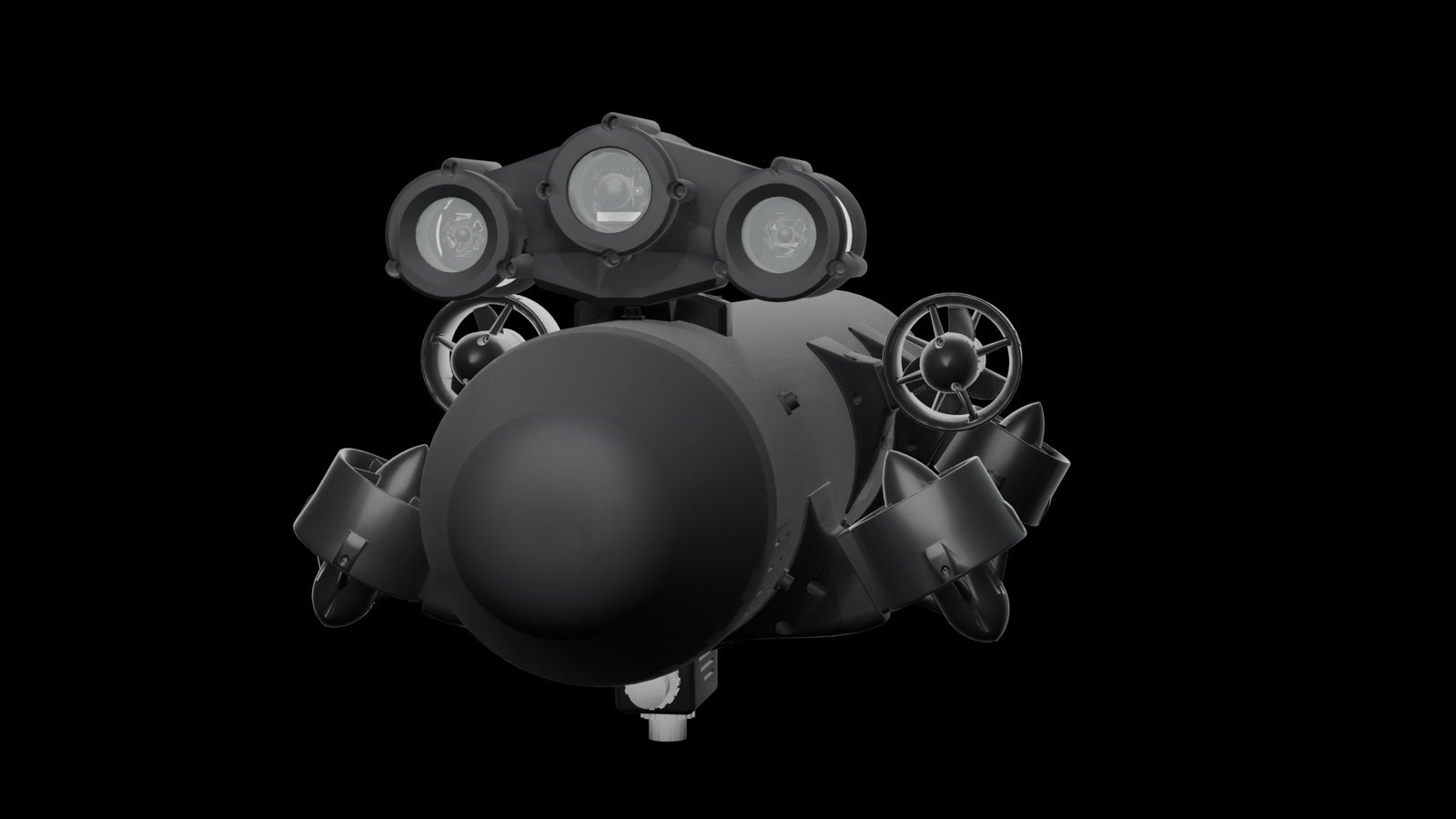
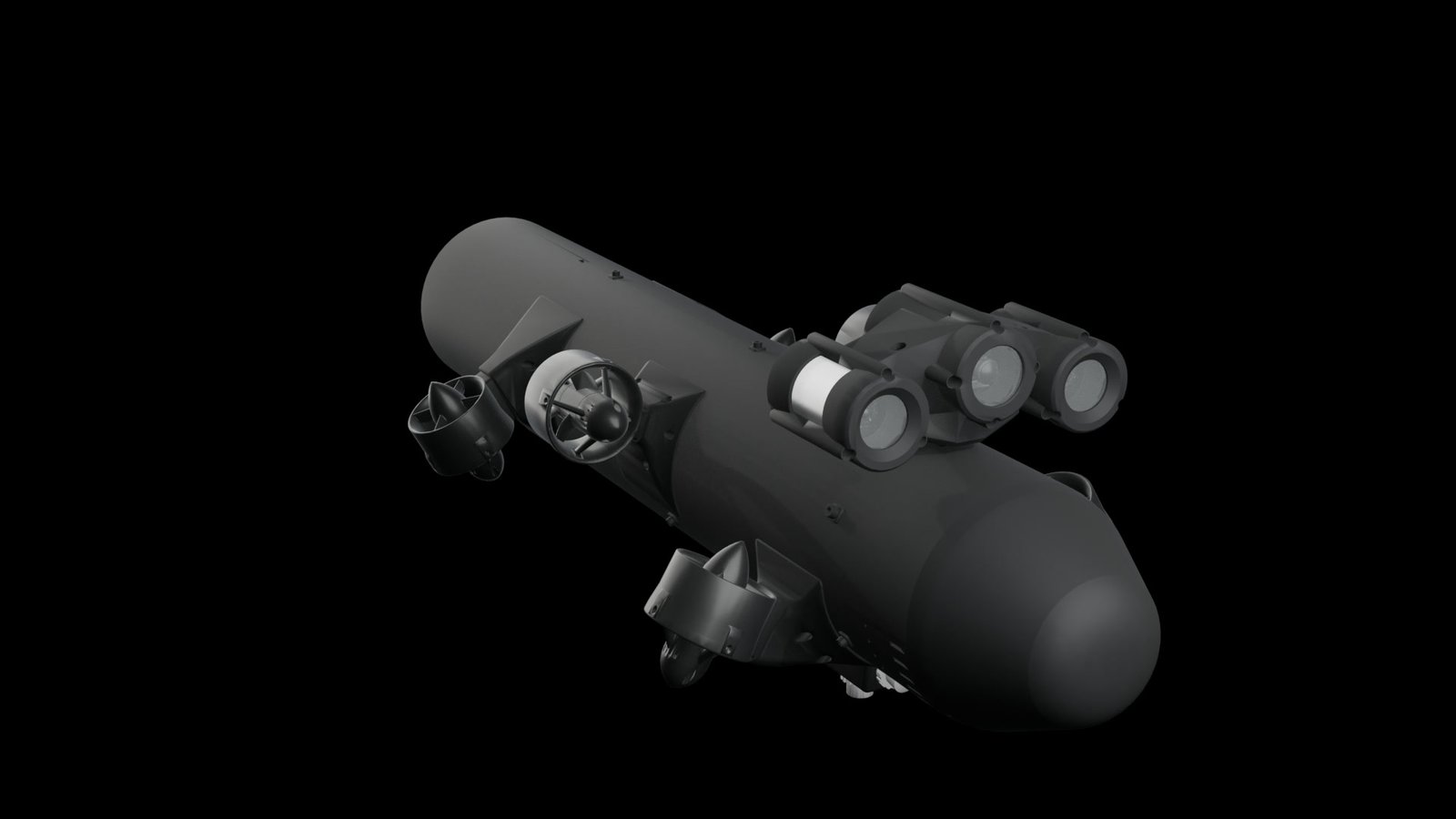
One drone.
One outcome.
A small, tethered underwater vehicle that travels to a single mine, confirms it, and is destroyed with it. Everything on board is chosen so it can be built in numbers.
- Length
- 1 m
- Dry weight
- 35 kg
- Depth rating
- 200 m
- Stable in current
- 2-3 kn
Camera and
light pod
A camera and a lamp at the front give the operator a live picture of the target. Nothing happens until a person has seen it and made the call.
- Video
- Live
- Sonar
- Forward, close range
- Final ID
- Operator, by eye
Six-axis
control
Thrusters let it hover, hold still and turn on the spot in front of a target, so the operator gets a steady picture before making the call.
- Speed
- 4+ kn
- Endurance
- 2 h
- Axes
- 6
- Control
- Semi-autonomous
Fibre-optic
tether
An optical fibre pays out from the tail as the drone travels. There is no radio signal to jam, and live video comes back all the way from the target.
- Range
- 2 km
- Link
- Optical fibre
- Carries
- Live video + control
Ultrasonic
sensors
Two ultrasonic sensors sit under the bow. One looks ahead and slightly down to pick up the target on the way in. The other looks straight down, so the drone can hold a steady height above the seabed.
- Forward
- Target range
- Downward
- Height above seabed
- Used for
- Final approach
The nose
A shaped charge sits in the nose. When it fires, the drone and the mine are destroyed together. The prototype carries no explosives.
- Payload
- Shaped charge
- Recovery
- Only if it finds nothing
- Prototype
- Inert
Scale to
the threat.
The systems in service today are expensive compared with the mines they clear: the single-use mine-clearing drones navies buy now cost about DKK 0.7 to 2.2 million each. The U-1A Legion takes on only the last step, close identification and neutralisation, and leaves finding the mines to the host vessel. That keeps it small, low-cost and simple to build in numbers.
Little kit needed
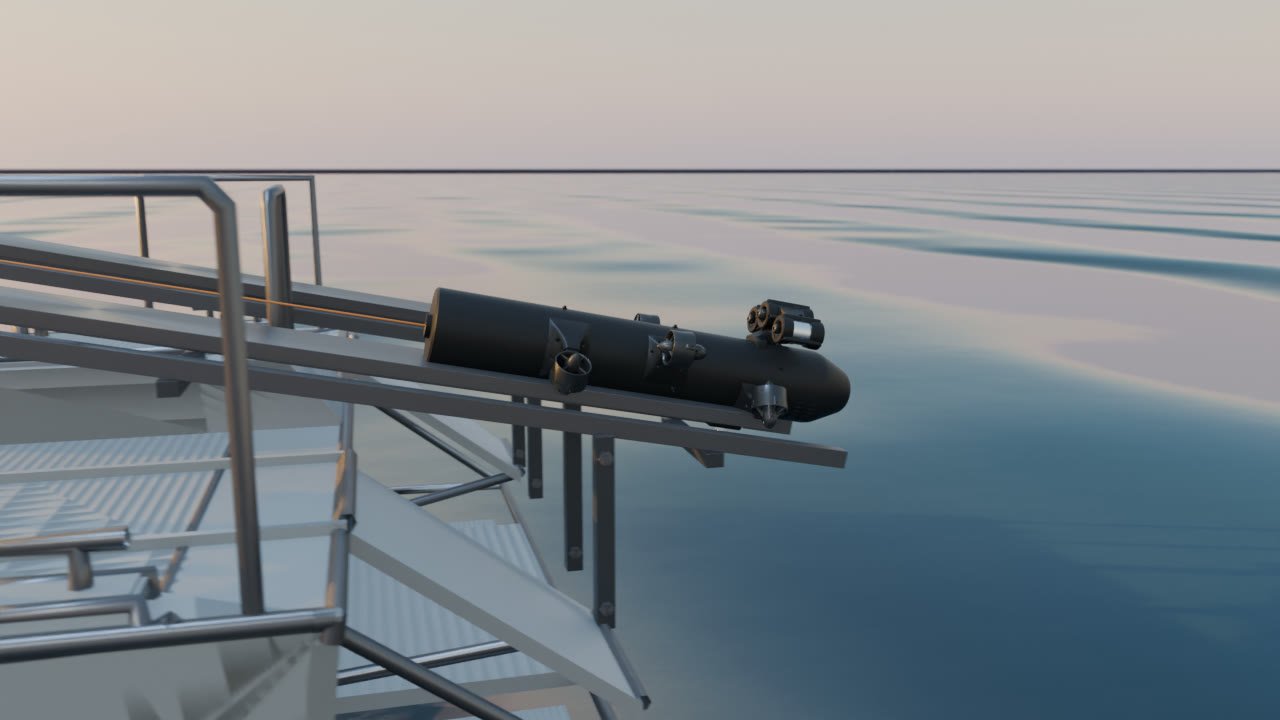
One person launches it from a small boat or an uncrewed surface vessel. No crane and no special ship.
Distance
The operator and the host vessel stay well outside the minefield. Nobody goes into the water.
Single use
Destroyed with the mine. Nothing to recover, reload or bring home.
Many at once
Several drones from one vessel, under one operator, clearing in parallel.
Launch.
Dive. Neutralise.
Renders of the full sequence, from the stern of an uncrewed vessel to the seabed.


Want to see
it dive?
Prototype v2 demonstrations start in 2027. Tell us what you need to see.